
A Spiral Galaxy in the Vortex of Cosmic Interaction
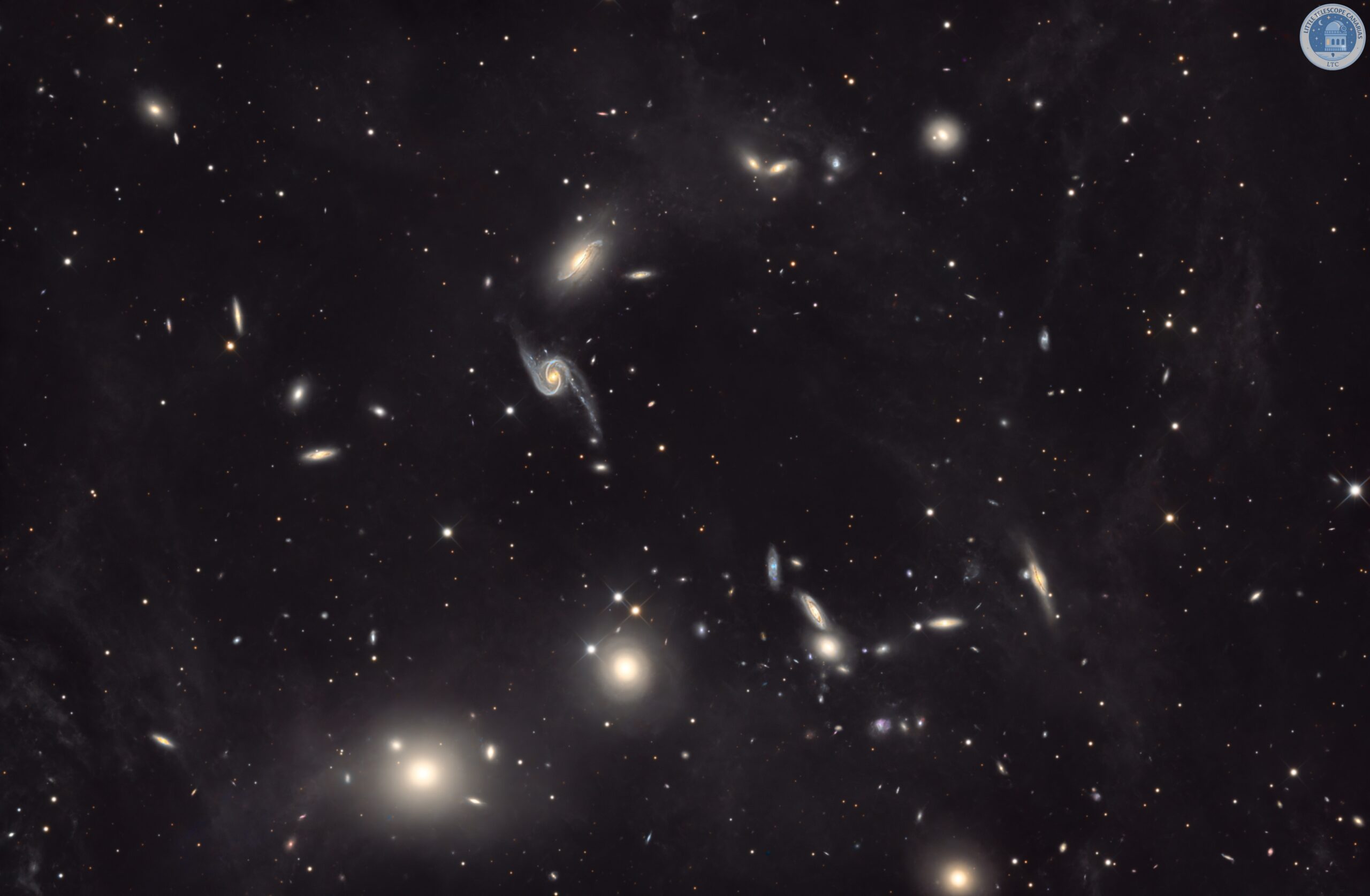
The galaxy NGC 90, also catalogued as part of the interacting system Arp 65, represents one of the most dynamic natural laboratories for studying high-impact galactic interactions. Located in the constellation Andromeda, this Grand Design spiral galaxy stands out not only for its structural beauty, but also for the violent tidal forces that have shaped its current morphology. Forming a physical pair with the elliptical/lenticular galaxy NGC 93, the Arp 65 system is a classic example of how the proximity between massive galaxies can drastically alter their gaseous content and star formation history.
Nature and Dynamics of Interaction
The nature of NGC 90 is intrinsically linked to its interaction with NGC 93. Research suggests that this pair is in a pre-merger stage, having experienced a close encounter approximately 100 to 250 million years ago. This tidal collision has caused a noticeable asymmetry in the spiral arms of NGC 90, which extend in the form of two long tidal tails that harbor young stellar populations.
One of the most fascinating aspects of this interaction is the massive displacement of its interstellar medium. Studies conducted with the GMRT radio telescope have revealed that a significant fraction of the neutral hydrogen (HI) in NGC 90 has been ejected from its optical disk, forming tidal debris that extends to the southeast of the system. This phenomenon highlights the efficiency of tidal forces in “stripping” galaxies of their gaseous fuel even before the final merger of their nuclei occurs.
Pecularities: A Hidden Medusa Galaxy?
Recently, the scientific community has proposed an innovative interpretation for the anomalies observed in NGC 90. Research led by Zasov et al. (2020) raises the possibility that NGC 90 is a “hidden” jellyfish galaxy [3]. This hypothesis is based on the detection of a giant HI cloud that contains almost half of the galaxy’s total gas mass, but is displaced and has a relative velocity of about 340 km/s with respect to the galactic center.
“The most intriguing feature of the galaxy is the presence of a previously discovered enormous HI ‘cloud’, which contains approximately half of the total gas mass of the galaxy, is strongly displaced outward, and has a velocity that exceeds the central velocity of the main galaxy by about 340 km/s.”
This structure suggests that, in addition to tidal forces, ram pressure exerted by the intergalactic medium could be sweeping gas out of the galaxy, creating a gaseous tail that, due to our perspective from Earth, appears projected along the line of sight, obscuring its true morphological extent.
Recent Research and Findings on arXiv
Publications in the arXiv repository have been fundamental in unraveling the mysteries of Arp 65. Long-slit spectroscopic studies have allowed the mapping of the metallicity and kinematics of ionized gas in NGC 90. A relatively flat oxygen abundance gradient (O/H) has been observed, a characteristic signature of galaxies that have undergone gas mixing due to gravitational interactions.
In addition, LINER (Low-Ionization Nuclear Emission-line Region) activity has been identified in its nucleus. This activity, combined with the presence of thermal shocks, indicates that the center of NGC 90 is being affected by energetic processes that do not depend solely on stellar radiation, but possibly on the fall of material toward the central black hole or the compression of gas induced by the collision.
In terms of star formation, GALEX and Spitzer data show that, although the interaction has triggered star birth in the tidal arms, there are regions of high HI gas density that remain “sterile.” This challenges the conventional idea that high gas density inevitably leads to star formation, suggesting that the dynamic conditions in the tidal debris of Arp 65 are particularly hostile to the collapse of molecular clouds.
Conclusion
NGC 90 (Arp 65) remains a priority object of study for understanding galactic evolution in dense environments. Its complex mix of tidal forces, possible ram pressure, and massive gaseous debris makes it a unique example of the resilience and transformation of spiral galaxies. Future research, likely using next-generation telescopes, will be crucial to confirm whether we are looking at a jellyfish galaxy in the midst of transformation or an exceptionally violent tidal system.