
Characterization of a Flocculent Spiral Galaxy
The galaxy M63, also known as NGC 5055 or popularly as the “Sunflower Galaxy,” is one of the most fascinating examples of spiral galaxies in our observable universe. Located approximately 27 million light-years from Earth, in the constellation Canes Venatici (The Hunting Dogs), this majestic cosmic structure has captured the attention of astronomers and space enthusiasts since its discovery in the 18th century.
Its nickname, “Sunflower Galaxy,” is neither accidental nor arbitrary. The arrangement of its spiral arms, when viewed through powerful telescopes such as Hubble, evokes the image of the geometric patterns present in the center of a sunflower. This visual resemblance, This visual resemblance, along with the yellowish tones of its core and the bluish hues of its star-forming regions, reinforce this botanical analogy that has endured in astronomical literature.
M63 belongs to a particular category of spiral galaxies called “fluffy,” a term derived from the Latin “flocculus” (small tuft of wool) and which perfectly describes its characteristic structure. Unlike large-scale spiral galaxies with well-defined, continuous arms, flocculent galaxies have fragmented, discontinuous arms that give the impression of a more chaotic or “cotton-like” structure. This flocculent characterization is not merely descriptive, but has profound implications for our understanding of the processes of star formation and galactic evolution.
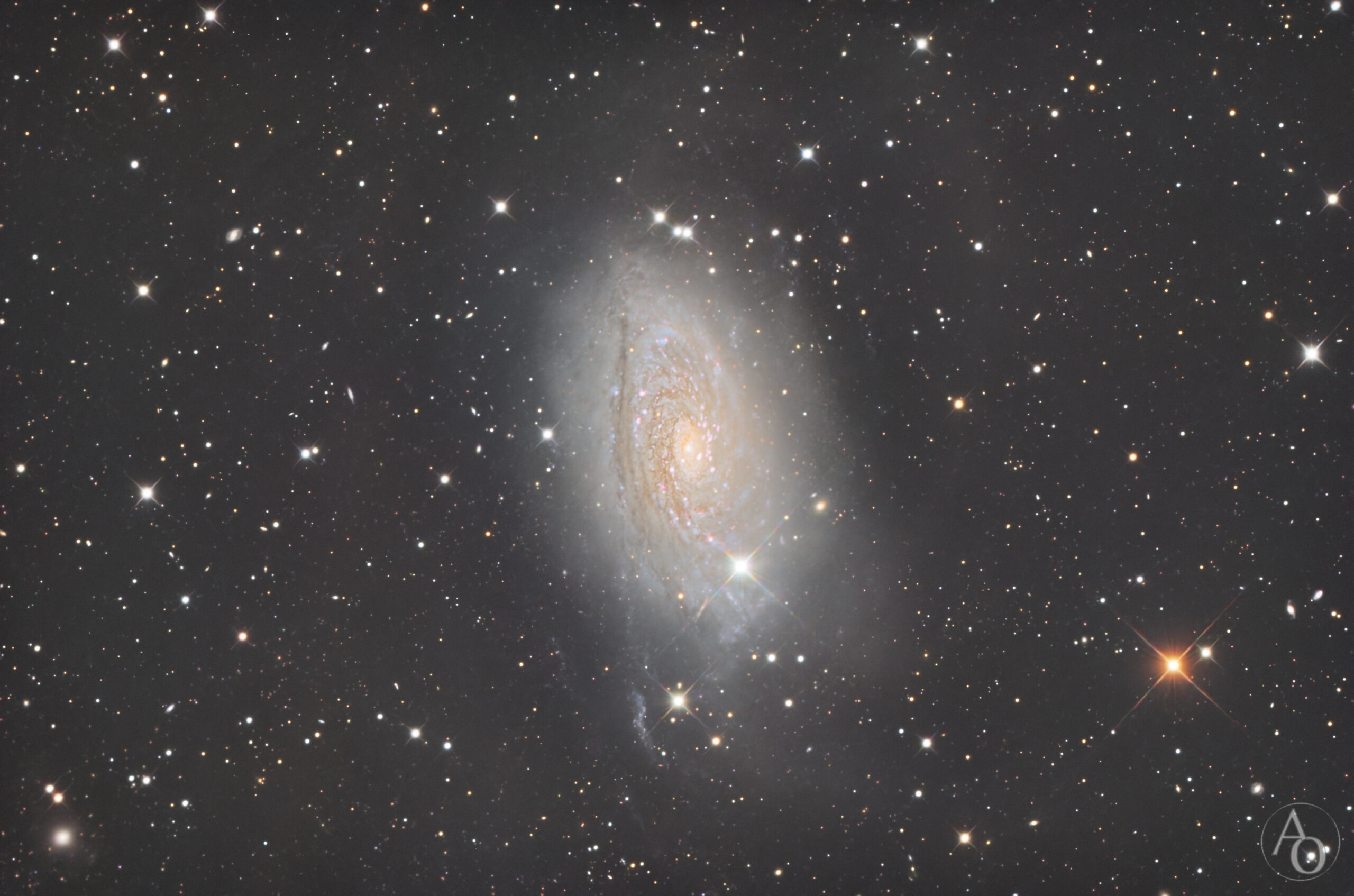
Originally cataloged by Pierre Méchain in 1779, M63 was later included as object number 63 in Charles Messier’s famous catalog, published in 1781. Méchain, a French astronomer and close collaborator of Messier, contributed a total of 24 objects to this catalog, M63 being the first of them. This inclusion in the Messier catalog, which was originally conceived as a list of objects that could be mistaken for comets, has ensured that M63 is one of the most studied celestial objects throughout the centuries.
With an apparent magnitude of 9.3, M63 is not visible to the naked eye, but it can be observed as a faint patch of light using small telescopes or powerful binoculars, especially during the month of May, when viewing conditions are optimal. However, its detailed study requires more sophisticated instruments, such as those used in modern scientific research, which have revealed its complex structures and physical properties. Its detailed study requires, however, more sophisticated instruments, such as those used in modern scientific research that have revealed its complex structures and physical properties.
The most recent observations have shown that M63 is composed of a large number of stars, some of which are as bright as the stars in the Milky Way.
In this article, we will explore the characteristics of M63 in depth, with special emphasis on its flocculent nature, analyzing its structure, composition, physical properties, and the star formation processes that occur within it. We will also examine its galactic environment, including recent research on its satellite galaxies and stellar streams in its halo, to provide a comprehensive and up-to-date overview of this fascinating cosmic object.
General features
The galaxy M63, also cataloged as NGC 5055, is classified as an Sbc spiral galaxy according to the Hubble sequence, indicating that it has a moderately prominent central bulge and relatively open spiral arms.However, its most distinctive feature, which sets it apart from many other spiral galaxies, is its flocculent nature, a trait that we will analyze in detail in later sections.
With a diameter of approximately 98,000 light-years, M63 is slightly smaller than our Milky Way, but it is still a galaxy of considerable size in the context of the observable universe. Its total mass has been estimated at approximately 5.1 × 10^11 solar masses, according to the most recent studies based on the dynamics of its satellite galaxies and its rotation curve. This mass includes both visible matter (stars, gas, and dust) and dark matter inferred from its dynamic properties
M63 is located in the northern constellation of Canes Venatici (The Hunting Dogs), a region of the sky located below the Big Dipper. Its celestial coordinates place it at a right ascension of 13h 15m 49.3s and a declination of +42° 01′ 45″, making it accessible to observers in the northern hemisphere for much of the year, with May being the optimal month for observation. With an apparent magnitude of 9.3, it is not visible to the naked eye, but can be easily detected with small telescopes or even powerful binoculars under dark sky conditions.
The history of the discovery of M63 dates back to June 14, 1779, when French astronomer Pierre Méchain observed it for the first time. Méchain communicated his discovery to his colleague and compatriot Charles Messier, who later included it as object number 63 in his famous catalog of celestial objects.
This catalog, originally conceived to list nebulous objects that could be mistaken for comets, has become an essential reference for professional and amateur astronomers alike. M63 has the honor of being the first of the 24
objects that Méchain would contribute to Messier’s catalog. Over the centuries, the study of M63 has evolved significantly with the advancement of astronomical technology. From early visual observations with rudimentary telescopes to sophisticated multispectral images obtained by the Hubble Space Telescope and other modern instruments, our understanding of this galaxy has been greatly enriched. These observations have revealed fascinating details about its structure, composition, and dynamics, allowing us to appreciate the complexity of this stellar system.
M63 is part of the M51 Group, a group of galaxies named after its brightest member, the M51 galaxy (also known as the Whirlpool Galaxy). This group, in turn, is part of the Virgo Supercluster, a vast cosmic structure that includes numerous groups and clusters of galaxies. M63’s membership in this group has important implications for its evolution, as gravitational interactions between members of the same group can significantly influence the morphology and dynamics of individual galaxies.
Characterization as a flocculent galaxy
The galaxy M63 (NGC 5055) represents one of the most notable and studied examples of what is known in astronomy as a “fluffy spiral galaxy.” This classification, far from being merely descriptive, constitutes a fundamental category for understanding certain processes of galactic evolution and star formation that differ significantly from those observed in other spiral galaxies.
The term “fluffy” derives from the Latin “flocculus,” meaning a small tuft of wool or cotton, and perfectly describes the visual appearance of these galaxies. Unlike “grand design” spiral galaxies, which exhibit well-defined, continuous, and symmetrical spiral arms, fluffy galaxies such as M63 have a fragmented spiral structure, with multiple discontinuous segments of arms that give the galactic disk a “cotton-like” or “fluffy” appearance.
In the specific case of M63, although technically it only has two main spiral arms, detailed observation reveals that many segments appear to coil around its yellowish core, creating the visual illusion of a more complex structure. This particular arrangement of the arms is precisely what evokes the image of the center of a sunflower, thus justifying its popular nickname of “Sunflower Galaxy.” The images captured by the Sunflower Galaxy.” Images captured by the Hubble Space Telescope have allowed us to appreciate this flocculent structure in extraordinary detail, showing how the fragmented arms shine brightly due to the presence of giant blue-white stars that have recently formed.
The flocculent nature of M63 has profound scientific implications, especially with regard to star formation processes. Star formation is one of the most fundamental processes in the configuration of the universe, not only because it gives rise to new stars, but also because of its role in the formation of planetary systems and the evolution of galaxies. However, the exact mechanisms that drive this process remain the subject of intense scientific study and debate.
In large-scale spiral galaxies, well-defined arms act as density waves that compress interstellar gas, triggering the formation of new stars in relatively orderly patterns. In contrast, in fluffy galaxies such as M63, the absence of well-defined spiral arms suggests that star formation processes follow different dynamics, possibly more localized and less dependent on large-scale structures.
Observations at different wavelengths have been crucial to better understanding the flocculent structure of M63. While the fragmented arms are evident in visible light, infrared observations reveal more clearly the distribution of gas and dust, essential components for star formation. These multispectral observations have confirmed that, despite its fragmented appearance, there is an underlying coherence in the spiral structure of M63, with star formation patterns that follow certain regularities despite the apparent discontinuity of the arms.
Comparing M63 with other flocculent galaxies has allowed astronomers to identify common patterns and significant differences. Some flocculent galaxies show signs of past interactions with other galaxies, which could explain the disturbance of their spiral arms. However, M63 appears to be relatively isolated in this regard, suggesting that its flocculent structure could be the result of internal processes of galactic evolution rather than external influences.
The study of flocculent galaxies such as M63 represents an important frontier in modern astrophysics. By better understanding how these structures form and evolve, scientists hope to gain new insights into the complex processes that govern star formation and galactic evolution in general. M63, with its visual beauty and intriguing structural features, continues to be an invaluable cosmic laboratory for this research.
Structure and composition
The M63 galaxy has a complex and fascinating structure that deserves detailed analysis. Its cosmic architecture is composed of several distinctive elements that, together, make up this impressive star system. In the center of M63 is a compact, bright nucleus with a yellowish hue, which houses older and more evolved stars. This nucleus, or galactic bulge, is not particularly large, but it is very bright and contains a large number of stars.
At the center of M63 is a compact, bright, yellowish nucleus that houses older, more evolved stars. This nucleus, or galactic bulge, is not particularly dominant compared to other spiral galaxies, which corresponds to its classification as type Sbc in the Hubble sequence.
The yellowish coloration of the nucleus is indicative of a mature stellar population, composed mainly of G- and K type stars, similar to our Sun but in more advanced stages of evolution. Surrounding this nucleus is the galactic disk, the region where the flocculent nature of M63 is most clearly evident. The disk is composed of gas, dust, and stars of various ages, although younger, hotter stars predominate, especially in the spiral arms. As mentioned above, unlike large-scale spiral galaxies, the arms of M63 do not form continuous, well-defined structures, but rather appear as multiple fragmented segments that wind around the nucleus.
These fragmented spiral arms are particularly notable for their bluish glow, resulting from the presence of massive, young, and hot O- and B-type stars. These stars, with surface temperatures that can exceed 30,000 K, emit mainly in the blue region of the visible spectrum and have relatively short lives in astronomical terms (on the order of millions of years, in contrast to the billions of years that a star like our Sun can live). Their presence in the spiral arms is direct evidence of active star formation processes in these regions.
Observations made with the Hubble Space Telescope have revealed in extraordinary detail the distribution of these young stars along the fluffy arms of M63. The images show how these fragmented arms shine intensely due to the radiation from these newly formed stars, creating a striking visual contrast with the more yellowish core.
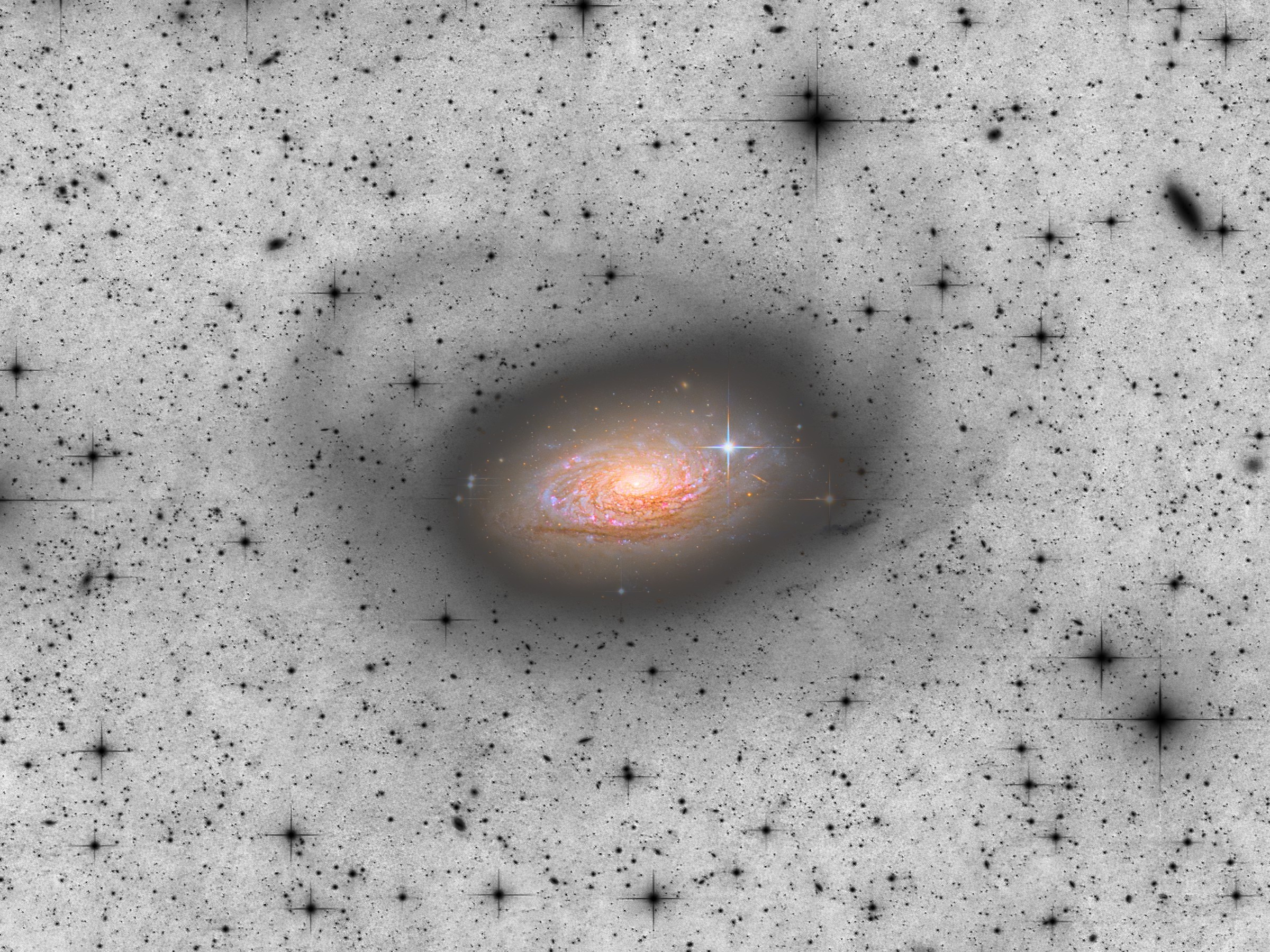
Beyond the visible disk, M63 has an extensive galactic halo, a low-density spherical region surrounding the entire galaxy. This halo contains ancient stars, globular clusters, and, as recently discovered, notable stellar streams. One of the most significant findings in this regard was documented in a study published in 2011 (Chonis et al.), which identified an arched structure with very low surface brightness in the halo of M63, consistent with being part of a stellar stream resulting from the disruption of a dwarf satellite galaxy.
This stellar stream, poetically described as “a sunflower petal” in the title of the study, extends approximately 29 kiloparsecs (about 94,600 light-years) from the center of the galaxy, with a projected width of 3.3 kiloparsecs (about 10,800 light-years). Its morphology is consistent with the visible part of a “large circle” stellar stream originated by the accretion of a dwarf satellite galaxy of approximately 10^8 solar masses over the last few billion years. This discovery is particularly relevant because it provides evidence of an ongoing minor merger process, which could have implications for our understanding of the evolution of M63 and its flocculent structure.
In addition to this main stellar stream, other “feathers” with low surface brightness have been detected in the halo of M63. Some of these structures could be extensions of spiral features related to the complex spiral structure of the galaxy, while others could be tidal debris associated with the disruption of the galaxy’s outer stellar disk as a result of the aforementioned accretion event.
A particularly interesting aspect of M63’s structure is its highly warped neutral hydrogen (HI) disk, with an inclination of approximately 20 degrees. This warping could be related to the ongoing minor merger process, providing further evidence of the influence of gravitational interactions on the galaxy’s current configuration.
Physical properties
The M63 galaxy has been the subject of numerous scientific studies that have made it possible to accurately determine its fundamental physical properties. These properties not only help us characterize this particular galaxy, but also contribute to our general understanding of the formation and evolution of fluffy spiral galaxies.
The total mass of M63 has been estimated at approximately 5.1 × 10^11 solar masses, according to the most recent studies based on the dynamics of its satellite galaxies. This estimate, documented in the work of Karachentsev et al. (2020), was made on a scale of approximately 216 kiloparsecs (about 704,000 light-years) and represents what is known as “orbital mass,” that is, the total mass inferred from the motion of objects orbiting the galaxy. It is important to note that this mass includes both visible matter (stars, gas, and dust) and dark matter inferred from its dynamic properties.
A particularly interesting feature of M63, highlighted in the same study, is its decreasing rotation curve. The rotation curve of a galaxy describes how the orbital velocity of stars and gas varies as a function of their distance from the galactic center . In most spiral galaxies, this curve tends to remain flat in the outer regions, which is interpreted as evidence of the presence of dark matter. However, in M63, the orbital velocity decreases with distance, an unusual behavior that it shares with some other nearby massive galaxies such as NGC 2683, NGC 2903, and NGC 3521.
This peculiarity in the rotation curve has significant implications for the mass-luminosity relationship of M63. According to Karachentsev et al., the relationship between orbital mass and luminosity in the K band (near infrared) for M63 and the other galaxies mentioned is approximately 4.8 ± 1.1 solar masses per solar luminosity. This value is remarkably low, representing only about 1/6 of the corresponding ratio for the Milky Way and M31 (Andromeda). This discrepancy suggests fundamental differences in the distribution of dark matter or in the processes of formation and evolution of these galaxies.
Regarding their X-ray emission properties, a detailed study by Luo et al. (2007) using data from the Chandra space observatory revealed fascinating aspects of the population of point sources of X-rays in M63. Analysis of the
data from Chandra’s ACIS S3 instrument detected a total of 43 point sources of X-rays within the galaxy’s two effective radii, with 31 sources located in the disk and the remaining 12 in the bulge.
These point sources of X-rays dominate the total X-ray emission of the galaxy, accounting for approximately 80% of the total counts in the energy range of 0.3-10 keV. The spectral fits performed in this study allowed the calculation of the luminosities in the 0.3-10.0 keV range of all detected point sources, finding that they span a wide range from a few 10^37 erg s^-1 to more than 10^39 erg s^-1.
A particularly interesting finding of this study is the difference in the X-ray luminosity function (XLF) between the bulge and disk populations. After compensating for the incompleteness at the low luminosity end, the After compensating for incompleteness at the low luminosity end, it was found that the corrected XLF of the bulge population fits well to a broken power law model with a break at 1.57 × 10^38 erg s^-1, while the of the XLF of the disk population agrees with a simple power-law distribution with a slope of 0.93.
The disk population is significantly richer in sources with luminosities greater than approximately 2 × 10^38 erg s^-1 than the bulge population. This suggests that the disk may have experienced relatively recent and strong bursts of star formation that significantly increased the population of high-mass X-ray binaries (HMXBs), although ongoing star formation bursts are also observed in the nuclear region.
These physical properties, from its total mass and rotation curve to its X-ray emission characteristics, provide a comprehensive view of M63 as a complex and dynamic galactic system, with peculiarities that distinguish it from other spiral galaxies and continue to challenge our understanding of galactic evolution.