
The Beauty of Transformation: Exploring NGC 7008
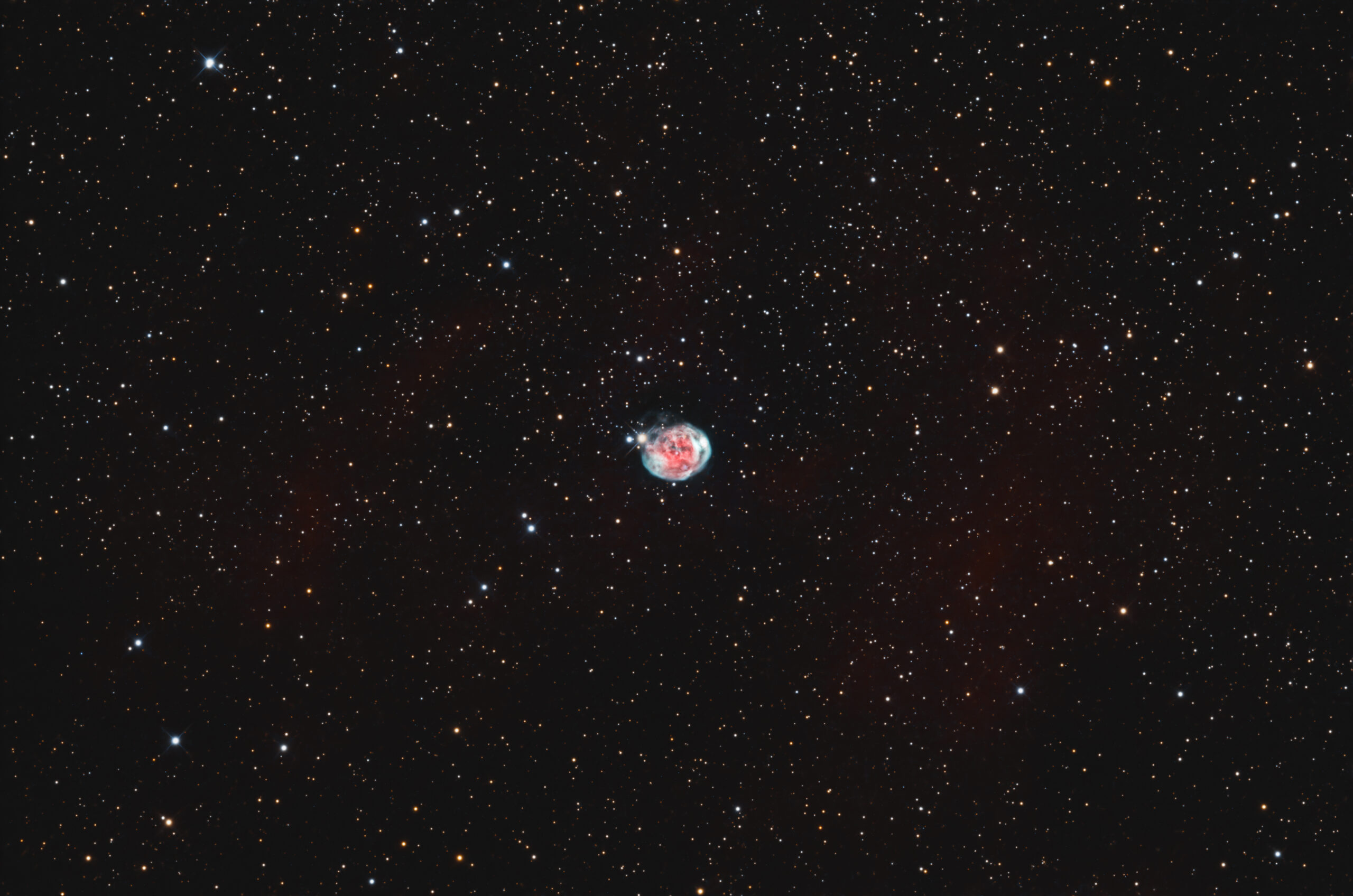
In the field of stellar evolution, I have always been fascinated by the final stage of the life of stars like our Sun: the formation of planetary nebulae. These objects, despite their misleading name (which stems from their planet-like appearance through small telescopes), are actually the gas and dust envelopes expelled by dying stars. Among them, NGC 7008, popularly known as the Fetus Nebula, is a particularly captivating specimen. Located in the constellation Cygnus, about 2,800 light-years away, this nebula—approximately one light-year in diameter—offers us a unique window into the complex processes that occur when a star exhausts its nuclear fuel.

Intricate Morphology: A Fetus or a Cosmic Caterpillar?
The Fetus Nebula owes its name to its distinctive shape, which is often described as oval or kidney-shaped, evoking the silhouette of a human fetus. However, its morphology is far more complex than a simple analogy suggests. By observing NGC 7008 with advanced telescopes and narrow-band filters, we reveal a richly detailed internal structure: multiple knots, filaments of ionized gas, and regions of varying densities and temperatures. False-color images, which highlight the emission of hydrogen (red) and doubly ionized oxygen (blue/green), show an intricate network of gas that is actively expanding.
Kinematics studies, which analyze the motion of gas within the nebula, have revealed a complex expansion velocity field. This is typical of more evolved planetary nebulae, where the interaction between stellar winds and the surrounding medium, as well as possible episodic ejections of material, give rise to these irregular and asymmetrical shapes. Understanding the dynamics of this expansion is crucial for reconstructing the history of the progenitor star’s mass loss.
The Burning Heart: The Central Star and Its Mysterious Companion
At the center of NGC 7008 lies the remnant of the star that created it: a hot, luminous star that has exhausted its supply of hydrogen and helium fuel in its core. This star, now in its nascent white dwarf phase, emits intense ultraviolet radiation that ionizes the surrounding gas, causing it to glow. It is the energy source that illuminates the entire nebula.
One of the most intriguing lines of research on NGC 7008 focuses on the possibility that its central star is not solitary, but rather part of a binary system. Observations made with the Hubble Space Telescope have suggested that the point spread function (PSF) of the central star is slightly broader than expected for a single star, which could indicate the presence of a nearby companion. The existence of a central binary could explain many of the nebula’s morphological complexities, as the gravitational interaction between the two stars can shape the ejection of material into non-spherical forms.
Furthermore, recent studies have allowed for a refinement of the interstellar extinction toward the central star of NGC 7008. Precisely determining how much light from the star is absorbed by the dust between us and the nebula is essential for calculating its intrinsic luminosity and, consequently, its temperature and mass. These data are vital for refining our models of stellar evolution and better understanding the properties of white dwarfs.
Future Prospects: Unraveling the Secrets of Stellar Death
NGC 7008 serves as a constant reminder of the beauty and complexity of the stellar life cycle. Every new observation, every new analysis, brings us one step closer to understanding how stars like our Sun end their lives, enriching the universe with the elements necessary for the formation of new stars and planets.
The questions driving our research are many: Can we confirm the binary nature of its central star, and how does this influence the shape of the nebula? What do variations in the gas’s chemical composition tell us about the history of the progenitor star? With the help of next-generation telescopes, such as the James Webb Space Telescope, we hope to obtain images and spectra of NGC 7008 with unprecedented resolution and sensitivity. These observations will allow us to probe the innermost regions of the nebula and its central star, perhaps revealing the final secrets of this fascinating Fetus Nebula.