The Fascination of Galactic Interactions: The Case of Arp 286
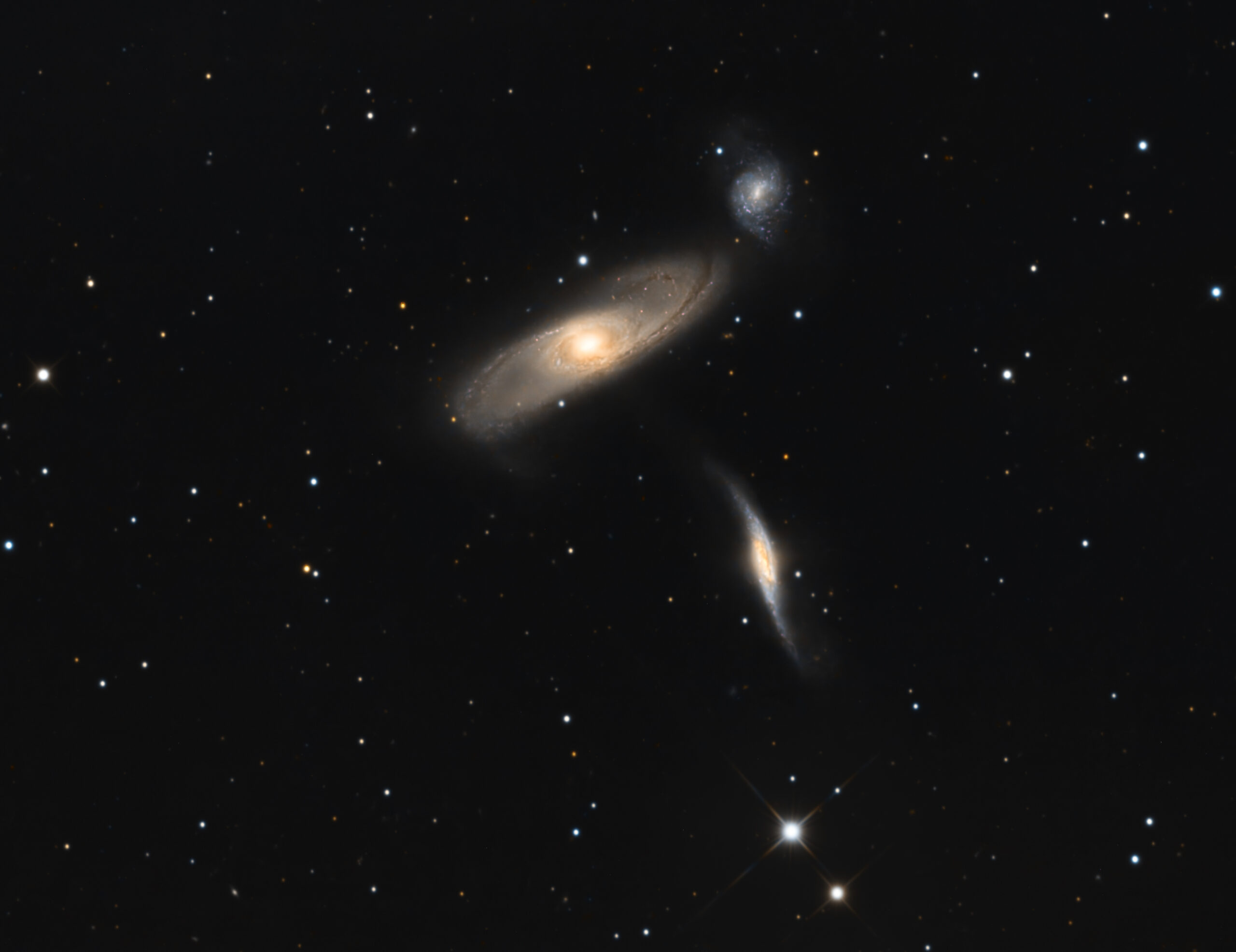
As an astrophysicist, my work focuses on unraveling the mysteries of galactic evolution, and few phenomena are as revealing as interactions between galaxies. The Arp 286 system, also known as KTG 54, is a stellar example of this cosmic dance. Located in the constellation Virgo, at a distance of between 65 and 90 million light-years, Arp 286 is not a solitary galaxy, but a dynamic trio composed of the galaxies NGC 5566, NGC 5560, and NGC 5569 [1]. This system offers us a natural laboratory for studying how gravitational forces shape and transform galaxies over cosmic time.
The Gravitational Ballet: NGC 5566 and Its Companions
At the heart of Arp 286 lies NGC 5566, an imposing barred spiral galaxy that dominates the system. Its spiral arms, though majestic, reveal subtle distortions—the unmistakable signature of an interactive past and present. Beside it, NGC 5560 appears as a spiral galaxy visibly affected by tidal forces. Its arms are elongated and its overall shape is irregular, an eloquent testimony to the intense gravitational pull exerted by its more massive neighbor [2]. Finally, NGC 5569, a smaller and more compact spiral galaxy, completes this trio; although its interaction is less dramatic at first glance, it remains a key player in the system’s overall dynamics.
The gravitational interaction between NGC 5566 and NGC 5560 is the primary driver of the transformations we observe. These tidal forces not only distort the morphology of the galaxies but also play a crucial role in the redistribution of interstellar gas and dust. This redistribution can trigger episodes of star formation, known as starbursts, by compressing the gas and causing its gravitational collapse [3].
Tidal-Induced Star Formation: A Look at the Evidence
One of the most fascinating aspects of interacting systems like Arp 286 is their ability to trigger the formation of new stars. Tidal forces act as catalysts, compressing molecular gas clouds and triggering star formation at an accelerated rate. Recent research, such as that by Gordon et al. (2025), has shown that galaxies exhibiting tidal features, such as distorted spiral arms or tidal tails, are significantly more likely to be experiencing a starburst. In fact, these studies suggest that galaxies with these characteristics are up to 10 times more likely to be in a starburst phase compared to isolated galaxies [3].
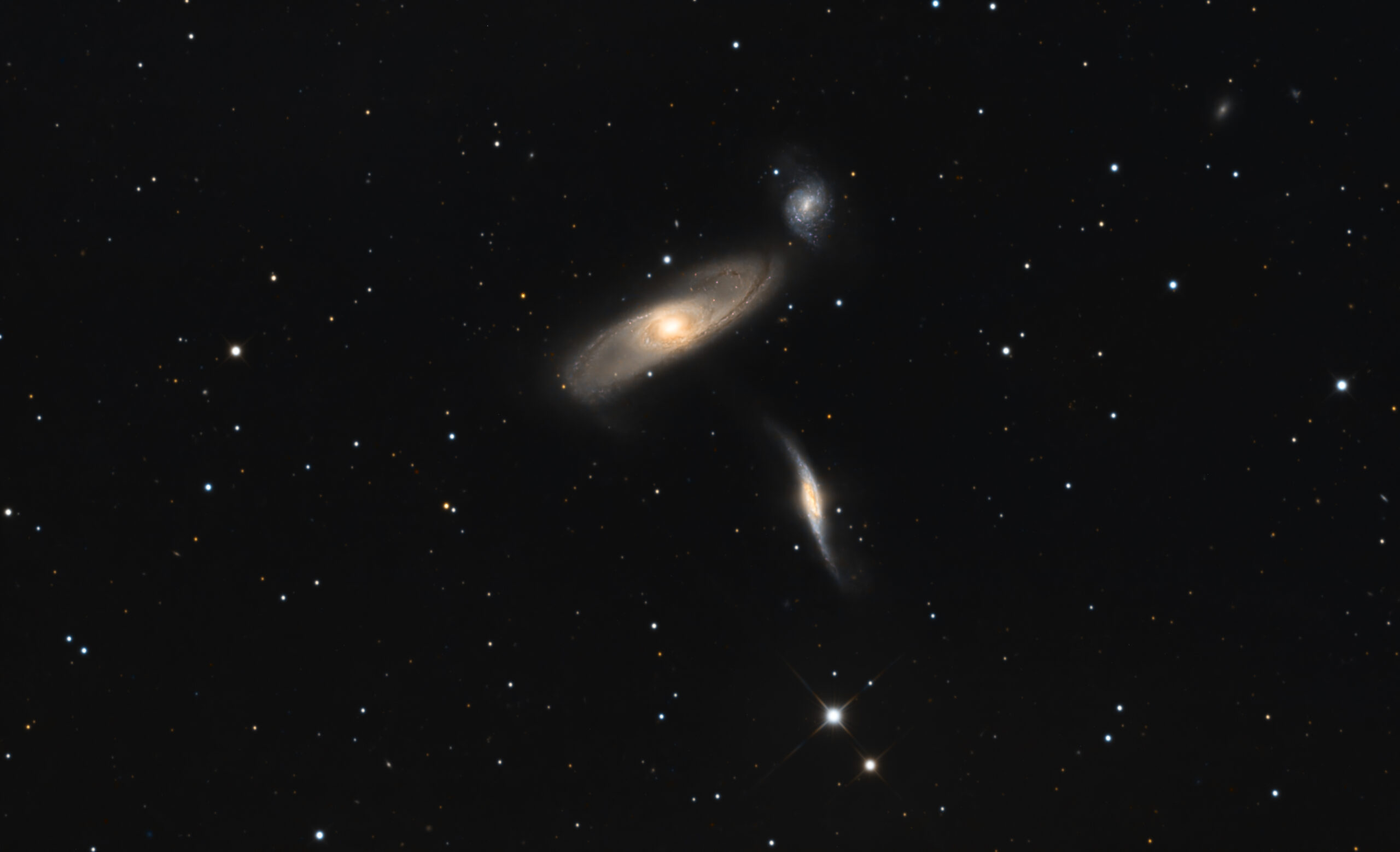
Arp 286, with its visibly distorted galaxies, is a perfect example of how these interactions can revitalize star formation in galaxies that might otherwise be aging. Studying these starburst episodes helps us understand how galaxies accumulate mass and evolve over their lifetimes.
Arp 286 as a Cosmic Laboratory
For me, as a researcher, Arp 286 is an invaluable cosmic laboratory. It allows us to study in detail the physical processes that occur during galactic interactions, from the transfer of angular momentum and mass to the triggering of star formation. “Faint tidal features,” which are often difficult to detect, are particularly important, as they may contain crucial clues about the history of the collision and the intensity of the interaction [3].
Furthermore, Arp 286 helps us understand the concept of “hierarchical growth” in the universe, where smaller galaxies are gradually absorbed or transformed by larger ones. This process is fundamental to the formation of the large galactic structures we observe today. The study of Arp 286 also allows us to investigate the phenomenon of star formation “quenching,” which often follows an initial burst of star formation as the gas is depleted or expelled from the galaxy.investigar el fenómeno del “apagado” (quenching) de la formación estelar, que a menudo sigue a un brote inicial de estrellas, a medida que el gas se agota o es expulsado de la galaxia.
Conclusión: Un Futuro de Descubrimientos
The Arp 286 system is a powerful testament to the dynamic and evolving nature of the universe. Each new observation, whether made with ground-based or space-based telescopes, provides us with a deeper insight into the complex interactions that shape galaxies. With the arrival of next-generation instruments, such as the James Webb Space Telescope, we expect to obtain images and spectroscopic data of Arp 286 with unprecedented resolution and sensitivity. These observations will allow us to further unravel the secrets of this cosmic trio, shedding light on the fundamental mechanisms driving the evolution of galaxies in our vast and fascinating universe.
References