A Star’s Final Act: The Butterfly Nebula
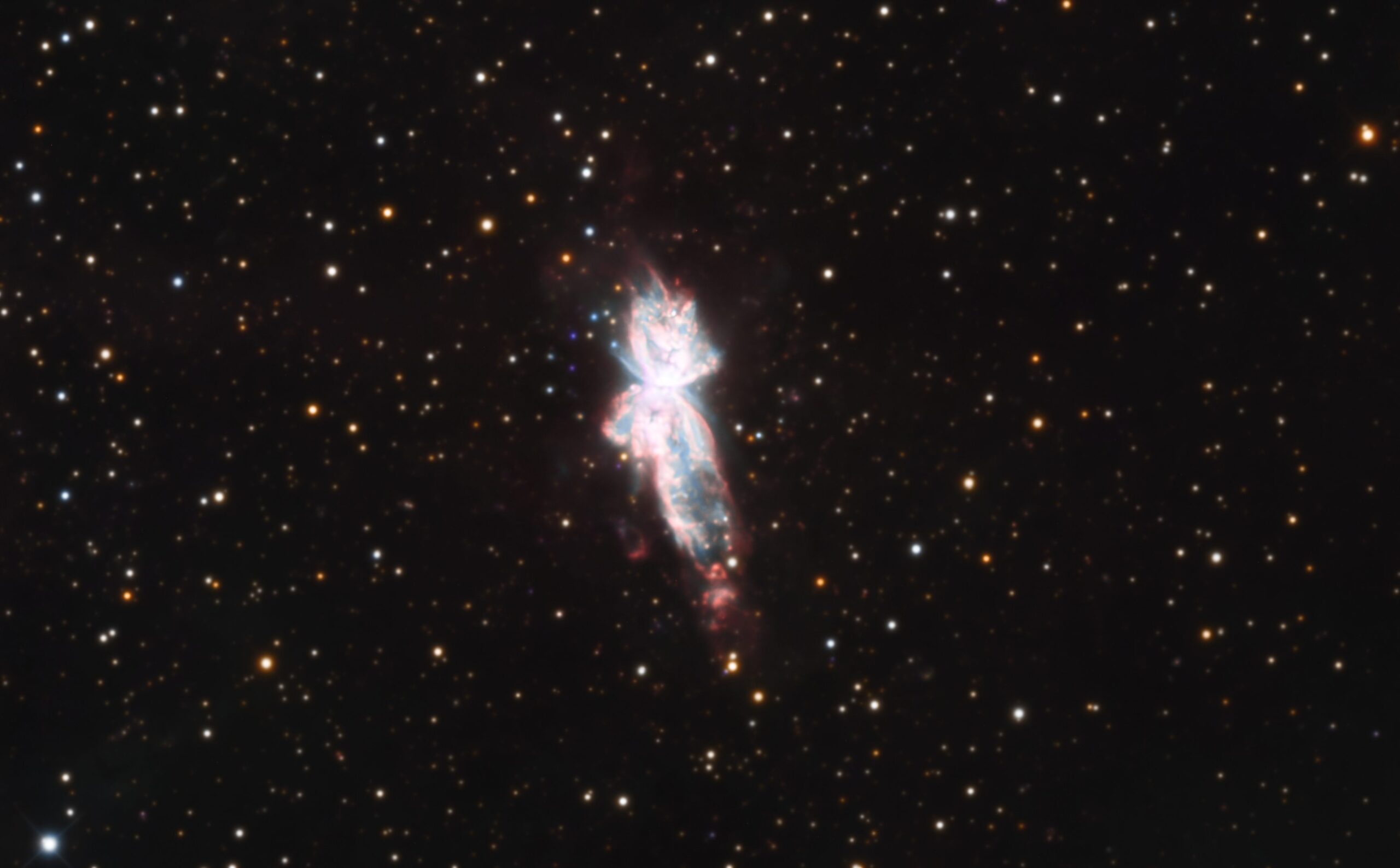
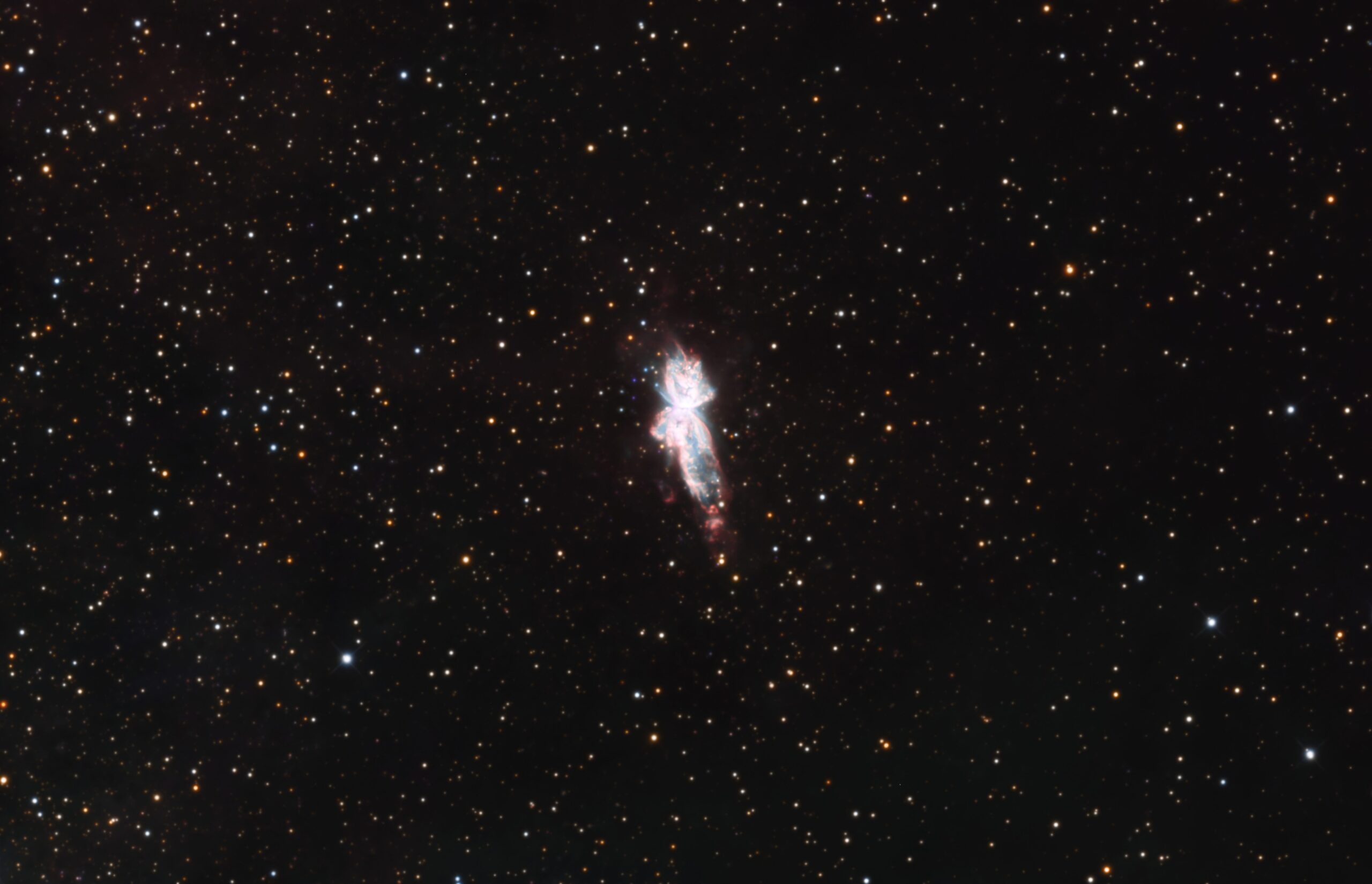
As a researcher in the fascinating field of astrochemistry and stellar evolution, I have always been captivated by the final stage of the life of intermediate-mass stars: the formation of planetary nebulae. These objects, true cosmic canvases, offer us an unparalleled view of the physical and chemical processes that occur when a star exhausts its nuclear fuel. Among the myriad of these celestial wonders, NGC 6302, popularly known as the Butterfly Nebula or the Insect Nebula, stands out for its extremely high central temperature, its complex bipolar morphology, and its surprising chemical richness. Located in the constellation Scorpius, at a distance of approximately 3,400 to 4,000 light-years, this nebula is a natural laboratory for studying the interaction between stellar radiation and the interstellar medium [1] [2].
The Burning Heart: A Hidden, Extreme Central Star
At the heart of the Butterfly Nebula lies one of the hottest known central stars of a planetary nebula (CSPN). With an estimated surface temperature between 220,000 K and 250,000 K, this star, which has a mass of approximately 0.64 solar masses, emits ultraviolet radiation so intense that it ionizes the surrounding gas to exceptional levels [1] [3]. However, despite its intrinsic brightness, the central star of NGC 6302 remains hidden from direct view at optical wavelengths. This is due to a dense equatorial torus of gas and dust that envelops it, absorbing its light and re-emitting it in the infrared [2].
Recent observations with the James Webb Space Telescope (JWST) have revealed that this torus is not a simple structure, but is “flared” and “distorted,” extending to considerable radii. This complex geometry of the torus is crucial for understanding how the central star ejects its material asymmetrically, giving rise to the nebula’s spectacular bipolar shape [4].
The Bipolar Morphology: Wings of Gas and Dust
The most striking feature of NGC 6302 is undoubtedly its bipolar shape, reminiscent of a butterfly’s outstretched wings. These two giant lobes of gas and dust are expanding at astonishing speeds, exceeding 600 km/s, and are heated to temperatures of over 20,000 K [2]. The formation of these bipolar structures is a subject of intense research. It is believed that the dense equatorial torus plays a key role, acting as a sort of “belt” that channels material ejected from the central star toward the poles, thereby creating the lobes. The interaction of fast stellar winds with this torus and with previously ejected material sculpts the intricate network of filaments and knots that we observe.
An Astrochemical Laboratory: The Oxygen-Carbon Paradox
What makes NGC 6302 particularly fascinating from an astrochemical perspective is its composition. Despite being an oxygen-rich (O-rich) nebula—which implies that the progenitor star had a carbon-to-oxygen ratio of less than 1—it also exhibits a surprising abundance of complex molecules and ices typically associated with carbon-rich environments. This “chemical paradox” poses a challenge to our models of molecular formation in planetary nebulae [1].
A recent milestone in the study of NGC 6302 was the first detection of the methyl cation (CH3+) in a planetary nebula, made in 2025 using the JWST. CH3+ is a key molecule in organic chemistry in environments irradiated by ultraviolet light, and its presence in an oxygen-rich nebula suggests that intense radiation from the central star is driving complex chemistry in the innermost regions of the nebula [1]. Furthermore, the detection of CO2 ice in the dense torus indicates the existence of very cold, sheltered regions within the nebula, where these molecules can survive the extreme radiation [4].
Future Prospects: Unraveling the Secrets of Cosmic Chemistry
NGC 6302 is an inexhaustible subject of study. The questions it raises are fundamental to understanding stellar evolution and the formation of molecules in the universe: How can the abundance of oxygen be reconciled with the presence of complex organic molecules? What role do collisions and extreme UV radiation play in the synthesis of these molecules? Can we use NGC 6302 to better understand prebiotic chemistry in stellar environments?
With the unprecedented power of the JWST and future observatories, we hope to obtain even more detailed data on the composition and dynamics of NGC 6302. These observations will allow us to build more accurate models of stellar material ejection, photochemistry in extreme environments, and, ultimately, the contribution of dying stars to the chemical enrichment of the cosmos. The Butterfly Nebula is not just a visual spectacle; it is a cosmic laboratory where the building blocks of life are forged.
References
[1] Bhatt, C., et al. (2025). Detection of CH3+ in the O-rich planetary nebula NGC 6302. arXiv:2509.14556.
[2] NASA Science. (2025). Planetary Nebula NGC 6302. [En línea]. Disponible en: https://science.nasa.gov/asset/hubble/planetary-nebula-ngc-6302/
[3] Wikipedia. NGC 6302. [En línea]. Disponible en: https://en.wikipedia.org/wiki/NGC_6302
[4] Matsuura, M., et al. (2026). Detection of CO2 ice in the planetary nebula NGC 6302. arXiv:2602.22366.