
The Fascinating End of a Star: The Planetary Nebula NGC 6765
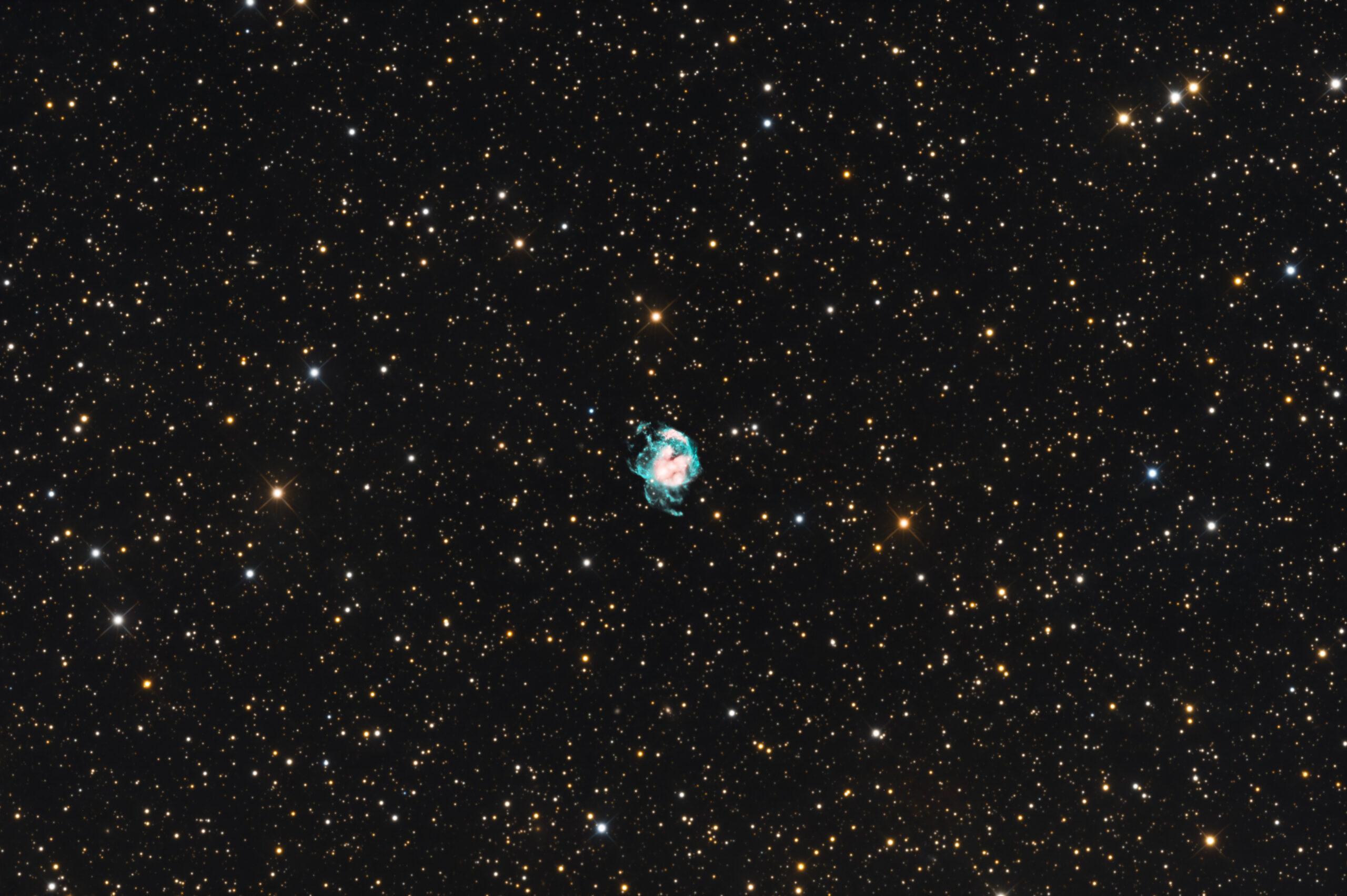
As a researcher in the vast field of astrophysics, my attention is often drawn to objects that mark the end of the life of stars like our Sun: planetary nebulae. These spectacular cocoons of gas and dust, expelled by dying stars, are cosmic laboratories where we can study the processes that shape matter in the universe. Among the multitude of these celestial gems, NGC 6765, also known as PK 62+9.1, stands out as an object of particular interest. Located in the constellation Lyra, at a distance of approximately 4,000 light-years, this planetary nebula, though small and irregular in shape, holds secrets about stellar evolution and the composition of its central stars [1].
Unusual Morphology: Beyond the Expected Symmetry
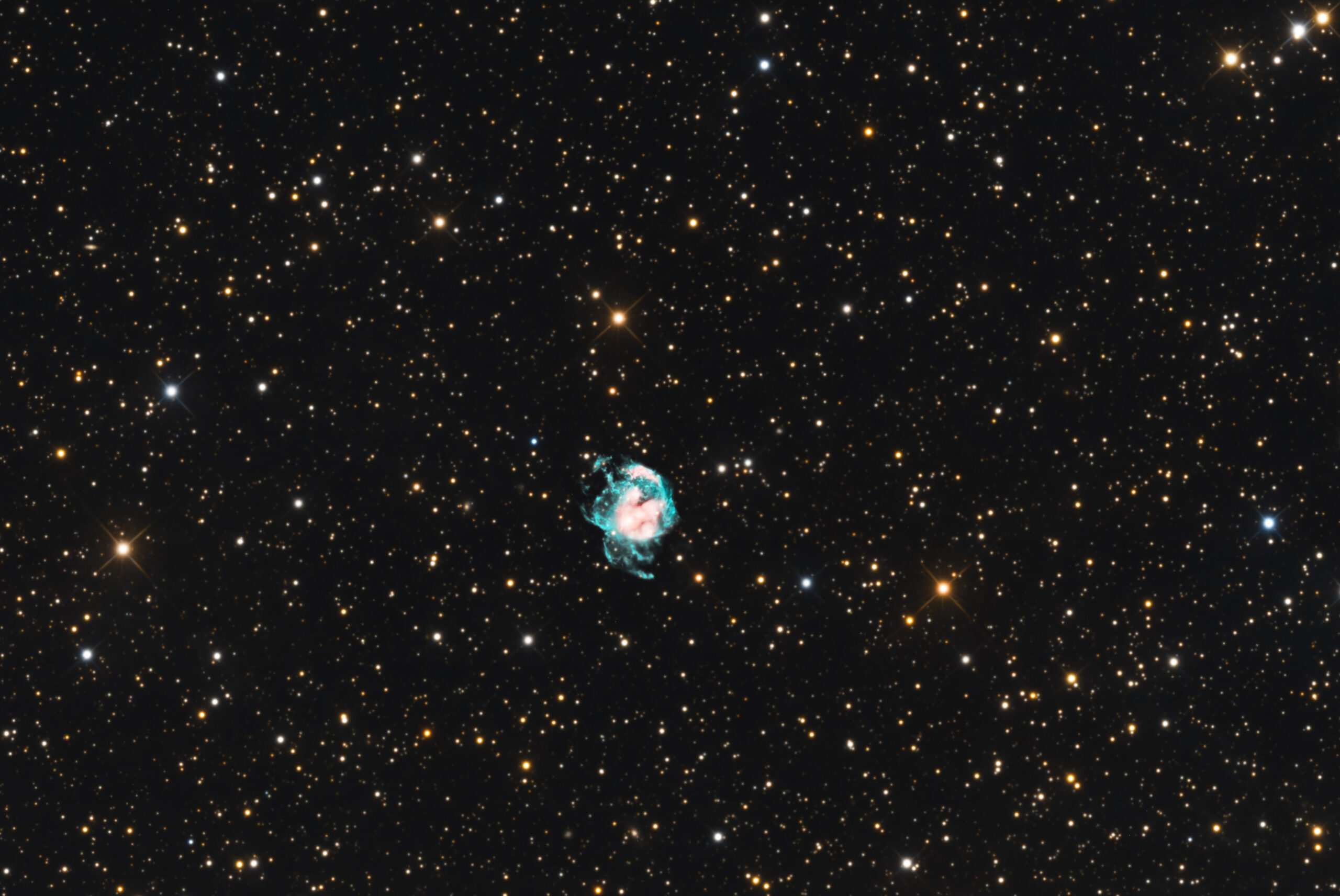
NGC 6765 is not a typical spherical or elliptical planetary nebula. Its morphology is strikingly irregular, characterized by the presence of two polar jets and a complex internal structure featuring knots and filaments of ionized gas [2]. This asymmetry is a distinctive feature that drives us to investigate the underlying mechanisms. Is it the result of a non-spherical ejection of material, perhaps influenced by a stellar magnetic field, or by the presence of a companion star that has shaped the nebula through gravitational interactions?
The radial velocity of -72.0 ± 25.0 km/s indicates that the nebula is approaching us, a crucial piece of data for modeling its expansion and its interaction with the surrounding interstellar medium. The complexity of its internal structure, visible in high-resolution images, suggests a history of material ejection that was not a single event, but rather a series of asymmetric stellar pulses or winds that have sculpted this unique shape [2].
The Heart of the Nebula: A Hydrogen-Depleted Central Star
At the center of NGC 6765 lies the star that gave rise to this nebula. This central planetary nebula star (CSPN) is an extremely hot and dense stellar remnant, on its way to becoming a white dwarf. However, what makes it particularly interesting is its composition: it has been identified as a hydrogen-deficient star [3].
Hydrogen-deficient stars are a rarity and offer vital clues about uncommon stellar evolutionary processes. The CSPN in NGC 6765 belongs to the spectral class PG1159 or O(He), meaning its atmosphere is dominated by helium, carbon, and oxygen, with very little or no hydrogen. Its effective temperature is extraordinarily high, estimated between 110,000 K and 180,000 K [3]. This extreme temperature is responsible for ionizing the nebula’s gas, causing it to glow with the light we observe.
Furthermore, the central star of NGC 6765 lies within the GW Vir pulsational instability strip. This means it is a pulsating variable star, making it an excellent target for asteroseismological studies. By analyzing these pulsations, we can obtain detailed information about the star’s internal structure, its mass, and its evolution, providing a deeper understanding of the final stages of stellar life [3].
Future Prospects: Unraveling the Secrets of Stellar Evolution
For me, as a researcher, NGC 6765 is a fascinating object of study that raises fundamental questions: What processes led the central star to lose almost all of its hydrogen? How does the unusual composition of its atmosphere influence the nebula’s outflow? Could the bipolar morphology of NGC 6765 be related to the nature of its central star or to the presence of a binary companion that has not yet been detected?
Future observations with next-generation telescopes, such as the James Webb Space Telescope (JWST), will be crucial. Its ability to observe in the infrared will allow us to penetrate the nebula’s dust and gas with unprecedented clarity, revealing details of its internal structure and the composition of its central star. By studying NGC 6765, we not only admire the beauty of stellar death, but also unravel the complex mechanisms governing the evolution of stars and, ultimately, the chemical composition of the universe.
References
[1] NGC 6765. Deep Sky Corner.
[2] NGC 6765, planetary nebula. Kopernik Observatory & Science Center.