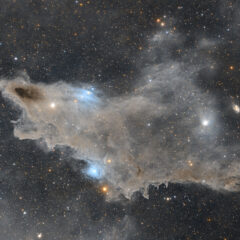
LDN1235
LDN 1235, also known as the “Shark Nebula,” is another one of those dark, dusty nebulae floating in space. Unlike bright nebulae, which emit or reflect light, LDN 1235 is a dark nebula, which means it is basically a giant Continue Reading

Un observatorio amateur para estudios profesionales.Estudios de Exoplanetas, fotometría de asteroides, supernovas, ocultación de objetos estelares, astrofotografía, el Observatorio Anunaki al servicio de astrónomos profesionales.
LDN 1235, also known as the “Shark Nebula,” is another one of those dark, dusty nebulae floating in space. Unlike bright nebulae, which emit or reflect light, LDN 1235 is a dark nebula, which means it is basically a giant Continue Reading
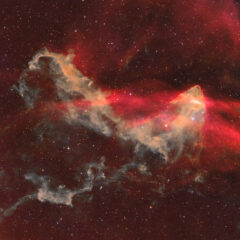
LBN 437 is a cosmic dust cloud found in space and belongs to a category of dark nebulae included in the LBN (Lynds’ Catalogue of Bright Nebulae). These nebulae are areas where there is so much dust and gas that Continue Reading
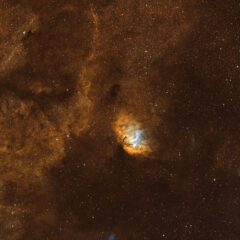
Sharpless 101, also called Sh2-101 is a Region HII nebula and also an emission nebula in the constellation Cygnus. It is also called the Tulip Nebula because it is shaped like a tulip in the images, cataloged by astronomer Steward Continue Reading
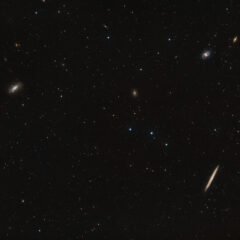
NGC 5907 is a spiral galaxy in the constellation Draco located 40 million light-years away. Of apparent magnitude 10.38, its surface brightness is 13.4 mag/arcsec. It was discovered by William Herschel in 1788. NGC 5907 appears edge-on from our perspective, Continue Reading
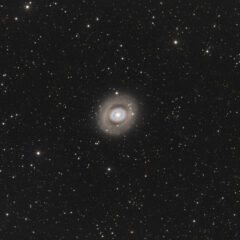
Messier 94, also known as NGC 4736 is a spiral galaxy in the constellation Canes Venatici. It was discovered by Pierre Méchain in 1781, and catalogued by Charles Messier 2 days later. The structure of M94 is characterized by three Continue Reading
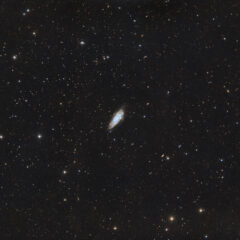
NGC 4559 is a spiral galaxy located in the Coma Berenices constellation within reach of amateur telescopes, at a distance of between 20 and 35 million light years (more possibly the latter distance based on its redshift). It is a Continue Reading
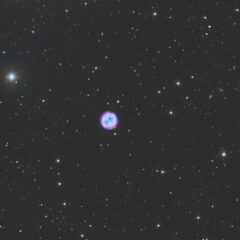
The Owl Nebula, also known as Messier 97 or NGC 3587, is a planetary nebula located in the constellation Ursa Major. It was discovered by Pierre Méchain in 1781. The name Owl Nebula was coined by Lord Rosse, who first Continue Reading
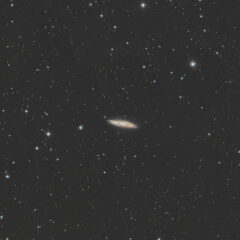
M108 is a spiral galaxy of type Sc in the constellation Ursa Major. Shown almost in profile, this shows little or no prominence or bulb with no strongly noticeable center, being a heterogeneous collection of features referred to as very Continue Reading
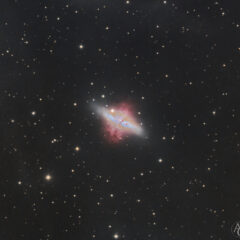
The Cigar Galaxy, also known as Irregular Galaxy M82 or NGC 3034, is an elongated and narrow irregular galaxy in the constellation Ursa Major. It is the prototype of a starburst galaxy, being characterized by a high rate of star Continue Reading
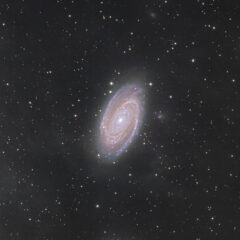
The Bode galaxy, also known as Spiral Galaxy M81 or NGC 3031, is a spiral galaxy located 12 million light years in the constellation Ursa Major. The Bode galaxy is presumed to contain approximately 250 billion stars, being slightly smaller Continue Reading