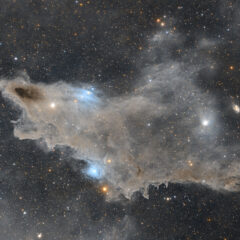
LDN1235
LDN 1235, also known as the “Shark Nebula,” is another one of those dark, dusty nebulae floating in space. Unlike bright nebulae, which emit or reflect light, LDN 1235 is a dark nebula, which means it is basically a giant Continue Reading

Un observatorio amateur para estudios profesionales.Estudios de Exoplanetas, fotometría de asteroides, supernovas, ocultación de objetos estelares, astrofotografía, el Observatorio Anunaki al servicio de astrónomos profesionales.
LDN 1235, also known as the “Shark Nebula,” is another one of those dark, dusty nebulae floating in space. Unlike bright nebulae, which emit or reflect light, LDN 1235 is a dark nebula, which means it is basically a giant Continue Reading
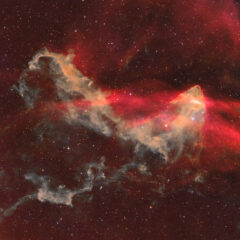
LBN 437 is a cosmic dust cloud found in space and belongs to a category of dark nebulae included in the LBN (Lynds’ Catalogue of Bright Nebulae). These nebulae are areas where there is so much dust and gas that Continue Reading
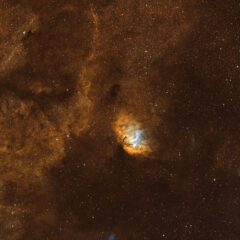
Sharpless 101, also called Sh2-101 is a Region HII nebula and also an emission nebula in the constellation Cygnus. It is also called the Tulip Nebula because it is shaped like a tulip in the images, cataloged by astronomer Steward Continue Reading
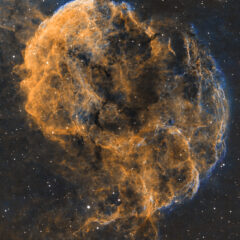
The SNR IC 443 is located in the galactic anticenter direction, close to the galactic plane. Many objects lie in the same region of sky: the HII region S249, several young stars, and an older SNR (G189.6+3.3). Image obtained from Continue Reading
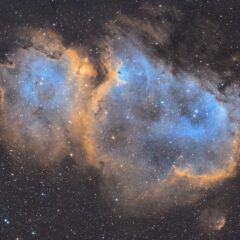
IC 1848 is a nebula located in our Milky Way that is also known as the Soul Nebula. It houses an immense number of stars, as well as open clusters. It is located in the Cassiopeia constellation, next to another Continue Reading
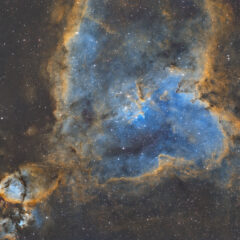
IC 1805 and IC 1848 are two emission nebulae located in the constellation Cassiopeia 7500 light-years from the Solar System, in the Spiral Arm of Perseus of the Milky Way. Both make up the stellar association Cassiopeia OB6.2 Also close Continue Reading
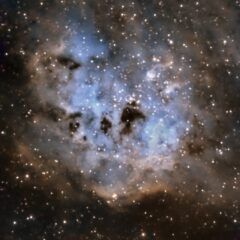
IC 410 also known as “The Tadpoles” is a young galactic cluster of stars. Formed inside the interstellar cloud just 4 million years old, intensely bright and hot stars power the gas. IC 410 is located about 10,000 light-years away Continue Reading
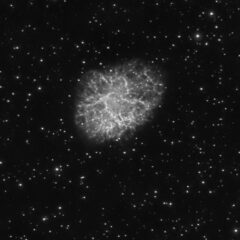
The Crab Nebula (also called M1, NGC 1952, Taurus A and Taurus X-1) is a plerion-type supernova remnant. It is the remnant of supernova SN 1054, observed and documented as a star visible in daylight by Chinese and Arab astronomers Continue Reading

The Laguna Nebula (also known as Messier 8, Messier 8, M8 or NGC 6523), is an emission nebula (specifically it is a Region H II) located in the constellation of Sagittarius. It is approximately 5,000 light-years away. It was discovered Continue Reading
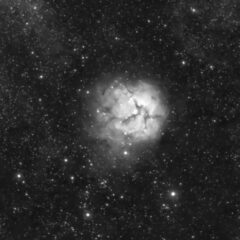
The Trifida Nebula (also known as Messier 20 and NGC 6514) is an H II region in the constellation Sagittarius. It was first catalogued in 1764 by the French astronomer Charles Messier. The name “Trifid”, coined by astronomer John Herschel, Continue Reading