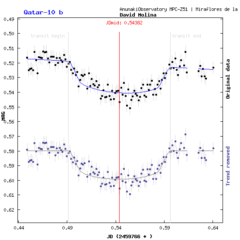
Qatar-10b
Qatar-10 b is a gas giant exoplanet orbiting an F-type star. Its mass is 0.736 Jupiter, it takes 1.6 days to complete an orbit of its star and it is 0.0286 AU from its star. Its discovery was announced in Continue Reading

Un observatorio amateur para estudios profesionales.Estudios de Exoplanetas, fotometría de asteroides, supernovas, ocultación de objetos estelares, astrofotografía, el Observatorio Anunaki al servicio de astrónomos profesionales.
Qatar-10 b is a gas giant exoplanet orbiting an F-type star. Its mass is 0.736 Jupiter, it takes 1.6 days to complete an orbit of its star and it is 0.0286 AU from its star. Its discovery was announced in Continue Reading
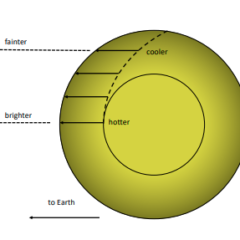
The effect of Stellar limb-darkening on transit light curves There are two main bodies involved in modeling a transit phenomenon: the star and the planet. We begin this educational journey by describing the stellar part of the transit model. Under Continue Reading
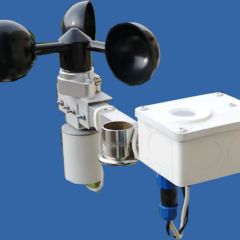
The TESS-W photometer allows us to share sky brightness data on the networkSTARS4ALL, but it is also a good complement to the astronomical observatory. With the standard version you have the sky brightness and the cloud estimate.Adding an anemometer and Continue Reading

The Orion Nebula spans a 10º region in the sky, and contains interstellar clouds, star clusters, H II regions, and reflection nebulae. The nebula forms an almost spherical cloud, where the maximum density is reached near the central point. The Continue Reading
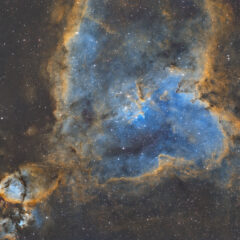
IC 1805 and IC 1848 are two emission nebulae located in the constellation Cassiopeia 7500 light-years from the Solar System, in the Spiral Arm of Perseus of the Milky Way. Both make up the stellar association Cassiopeia OB6.2 Also close Continue Reading
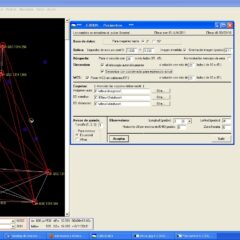
Excellent program created by Alfonso Pulido, great amateur astronomer member of the AstroHenares Association, which allows you to find out with total precision where our telescope points from an image of a stellar field. PROGRAM CONFIGURATION There are several possibilities Continue Reading
Maxim DL is a complete program for the management of CCD cameras and digital cameras. This program contains practically all the tools and utilities that can be of great help for the realization of astronomical images, both for scientific and Continue Reading
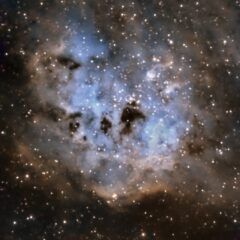
IC 410 also known as “The Tadpoles” is a young galactic cluster of stars. Formed inside the interstellar cloud just 4 million years old, intensely bright and hot stars power the gas. IC 410 is located about 10,000 light-years away Continue Reading
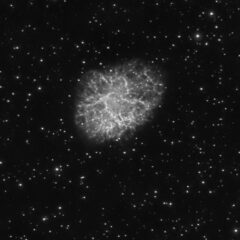
The Crab Nebula (also called M1, NGC 1952, Taurus A and Taurus X-1) is a plerion-type supernova remnant. It is the remnant of supernova SN 1054, observed and documented as a star visible in daylight by Chinese and Arab astronomers Continue Reading

The Laguna Nebula (also known as Messier 8, Messier 8, M8 or NGC 6523), is an emission nebula (specifically it is a Region H II) located in the constellation of Sagittarius. It is approximately 5,000 light-years away. It was discovered Continue Reading